
Commercial poultry feed formulation in Bangladesh requires balancing high-energy grains with crude protein and digestible amino acids (lysine and methionine) while keeping feed conversion ratio (FCR) under 1.50 for broilers. Meeting Department of Livestock Services (DLS) standards demands strict raw material moisture control (<14%) and steam conditioning at 80–85°C to eliminate pathogen loads and maximize feed intake.
The Economics of Poultry Feed Conversion in Bangladesh
Across the commercial farming hubs of Natore, Rajshahi, Bogura, and Gazipur, feed expenditure accounts for 68% to 72% of total operational cost. In a market where live bird farm-gate prices fluctuate frequently, feed conversion ratio (FCR) is the single most decisive factor determining farm solvency.
For a commercial broiler operation raising 5,000 birds to a 2.0 kg market weight, an FCR difference of just 0.15 (1.50 vs 1.65) represents 1,500 kilograms of wasted feed. At prevailing commercial market rates, that single variance drains over ৳1,05,000 in net farm margin per production cycle. Achieving a sub-1.50 FCR requires precise ration balancing, high-digestibility ingredients, and industrial pellet conditioning that prevents selective feeding by the flock.
Core Raw Material Standards & Quality Control
Consistent feed quality begins long before batching, inside the quality assurance laboratory. Grains procured across northern Bangladesh must pass strict physical and biochemical screening before entering the hammer mills:
- Yellow Maize (Corn): Supplies 55% to 65% of dietary metabolizable energy. Moisture content must remain below 13.0% to prevent Aspergillus flavus growth and aflatoxin contamination. Test weight should exceed 70 kg/hl with insect damage below 2%.
- De-Oiled Soybean Meal (DOC): The primary protein powerhouse. High-grade soybean meal delivers 44% to 48% crude protein. In-house testing monitors urease activity (keeping pH rise between 0.05 and 0.20) to confirm that anti-nutritional trypsin inhibitors have been thoroughly neutralized by thermal processing.
- Full-Fat Soya (FFS): Extruded full-fat soybean provides both high-density vegetable protein (36–38%) and essential linoleic acid (18% oil) to support rapid muscular development in starter broilers.
- Micro-Ingredients & Synthetic Amino Acids: Feed formulations utilize crystalline L-lysine hydrochloride and DL-methionine to match the ideal poultry amino acid profile, reducing excess dietary nitrogen and preventing wet litter syndrome.
- Mineral & Enzyme Matrix: High-grade dicalcium phosphate (DCP), fine limestone powder for shell formation, phytase enzymes to unlock phytate-bound phosphorus, and multi-strain toxin binders to immobilize field mycotoxins.
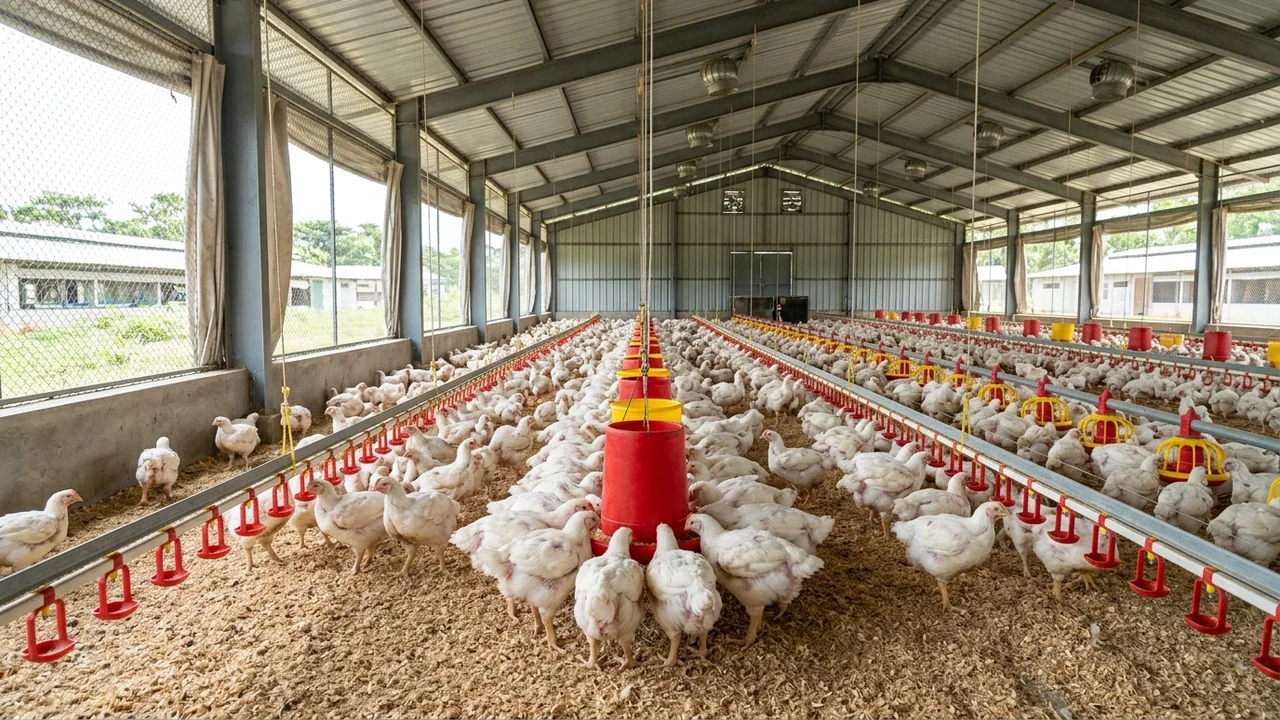
Clean automated feeding line inside a commercial broiler farm shed demonstrating optimal feed distribution and litter management.
Comprehensive Broiler & Layer Nutritional Specifications Matrix
To satisfy the biological demands of modern genetics (such as Cobb 500, Ross 308, and Novogen Brown), commercial diets must follow precise stage-specific nutritional densities:
| Feed Category | Target Age | Crude Protein (%) | ME (kcal/kg) | Calcium (%) | Avail. P (%) | Dig. Lysine (%) | Dig. Methionine (%) |
|---|---|---|---|---|---|---|---|
| Broiler Pre-Starter | Days 1–10 | 22.5–23.0% | 2,950–3,000 | 1.00% | 0.48% | 1.32% | 0.52% |
| Broiler Starter | Days 11–21 | 21.0–21.5% | 3,050–3,100 | 0.95% | 0.45% | 1.20% | 0.48% |
| Broiler Finisher | Days 22–32+ | 19.5–20.0% | 3,150–3,200 | 0.88% | 0.42% | 1.08% | 0.44% |
| Layer Chick Starter | Weeks 1–8 | 19.0–19.5% | 2,800–2,850 | 1.05% | 0.45% | 1.00% | 0.40% |
| Layer Grower | Weeks 9–17 | 15.5–16.0% | 2,750–2,800 | 1.00% | 0.40% | 0.75% | 0.34% |
| Layer Peak Production (Phase 1) | Weeks 18–45 | 17.5–18.0% | 2,750–2,800 | 3.80–4.00% | 0.42% | 0.88% | 0.42% |
Industrial Steam Conditioning & Pellet Durability (PDI)
Mash feed often leads to ingredient de-mixing, where dominant birds eat maize chunks and leave critical mineral powder behind. Industrial pelleting solves this by compacting the entire formula into uniform, heat-treated pellets:
- Steam Conditioning Temperature (80°C to 85°C): Injecting saturated dry steam for 35 to 45 seconds gelatinizes surface starches. This thermal activation acts as a natural binder, dramatically enhances digestive enzyme access, and eliminates potential Salmonella and coliform bacteria.
- Pellet Durability Index (>96%): Maintaining a PDI above 96% ensures pellets do not break into dust during road transport across regional dealerships. Feed fines exceeding 10% in commercial troughs directly suppress feed intake and increase beak irritation.
- Crumble Sizing: For day-old chicks up to day 10, pellets are crushed through corrugated rollers to produce uniform 1.8 mm to 2.2 mm crumbles that match chick mouth gape.
Combating Heat Stress in Northern Bangladesh Poultry Belts
During the blistering summer months in Natore, Rajshahi, and Chapainawabganj, ambient shed temperatures frequently exceed 36°C with relative humidity over 75%. Under severe thermal load, chickens hyperventilate (pant), expelling blood carbon dioxide and inducing respiratory alkalosis.
Formulation adjustments during hot seasons focus on reducing metabolic heat increment:
- Replacing Starch Energy with Supplemental Vegetable Fat: Digesting crude fat produces 30% less metabolic heat than metabolizing carbohydrates.
- Electrolyte Rebalancing: Supplying sodium bicarbonate (0.25% to 0.35%) helps restore blood bicarbonate buffers lost through rapid panting.
- Night Feeding Management: Shifting 45% of daily feed allowance to the cooler night hours (9:00 PM to 4:00 AM) encourages birds to eat when body heat dissipation is highest.
The Integrated Synergy: Genetics, Feed, and Biosecurity
Feed quality cannot operate in isolation from genetics and flock health. At our corporate network, Sunrise Poultry & Hatchery Ltd produces vigorous day-old broiler and layer chicks from parent stock housed in climate-controlled bio-secure sheds.
Furthermore, raw grain procurement is managed through SS Agro Trade Link to ensure rigorous laboratory testing prior to bulk storage, while flock biosecurity protocols leverage field products developed with Oxford Agro Chemical Industries Ltd. Continuous nutritional innovation is tested inside our dedicated Research & Development Division.
Farmer’s Field Diagnostic Checklist
Before filling commercial flock feeders, farm supervisors should verify three physical feed characteristics:
- The Finger Crush Test: A well-conditioned pellet should yield with firm finger pressure without shattering into fine powder.
- Water Stability Evaluation: Submerge 10 pellets in water; high-PDI pellets should maintain structural integrity for at least 4 to 6 minutes before gently swelling.
- Olfactory & Visual Inspection: Quality feed possesses a rich, toasted grain fragrance with a clean golden-yellow hue. Any sour, musty, or blackened notes indicate moisture decay or excessive heat scorch.
Frequently Asked Questions (Commercial Poultry Formulation)
What is the target FCR for commercial broilers in Bangladesh?
In well-managed commercial broiler sheds across Bangladesh, target FCR ranges between 1.45 and 1.52 at 32 to 34 days of age, achieving an average live weight of 1.9 to 2.1 kilograms. Formulations utilizing high-digestibility soybean meal and steam-conditioned crumbles consistently hit these parameters.
Why is corn moisture so critical in feed formulation?
Yellow corn with moisture above 13.5% rapidly fosters fungal colonization, primarily Aspergillus flavus. This produces aflatoxins that cause severe liver damage, immunosuppression, and feed refusal in young chicks. Feed mills must reject high-moisture maize lots or pass them through industrial grain dryers immediately.
Why do laying hens require coarse limestone particles?
Eggshell calcification takes place predominantly at night when birds are not actively eating. Coarse limestone (2.0–4.0 mm) dissolves slowly in the gizzard, releasing calcium into the bloodstream steadily during midnight shell formation, preventing thin-shelled eggs and cage layer fatigue.
How does pellet durability index (PDI) impact poultry profit?
When PDI falls below 90%, feed sacks contain high proportions of loose dust. Broilers expend extra metabolic energy searching for pellets while leaving vitamin and amino acid powder at the bottom of feeding trays, directly raising FCR and slowing growth rates.
Partner with SS Feed Industries Ltd for High-Performance Poultry Rations
Manufactured at our Category A computerized feed mill in Hugolbaria, Natore, our broiler and layer rations deliver verified FCR advantages for commercial poultry enterprises.